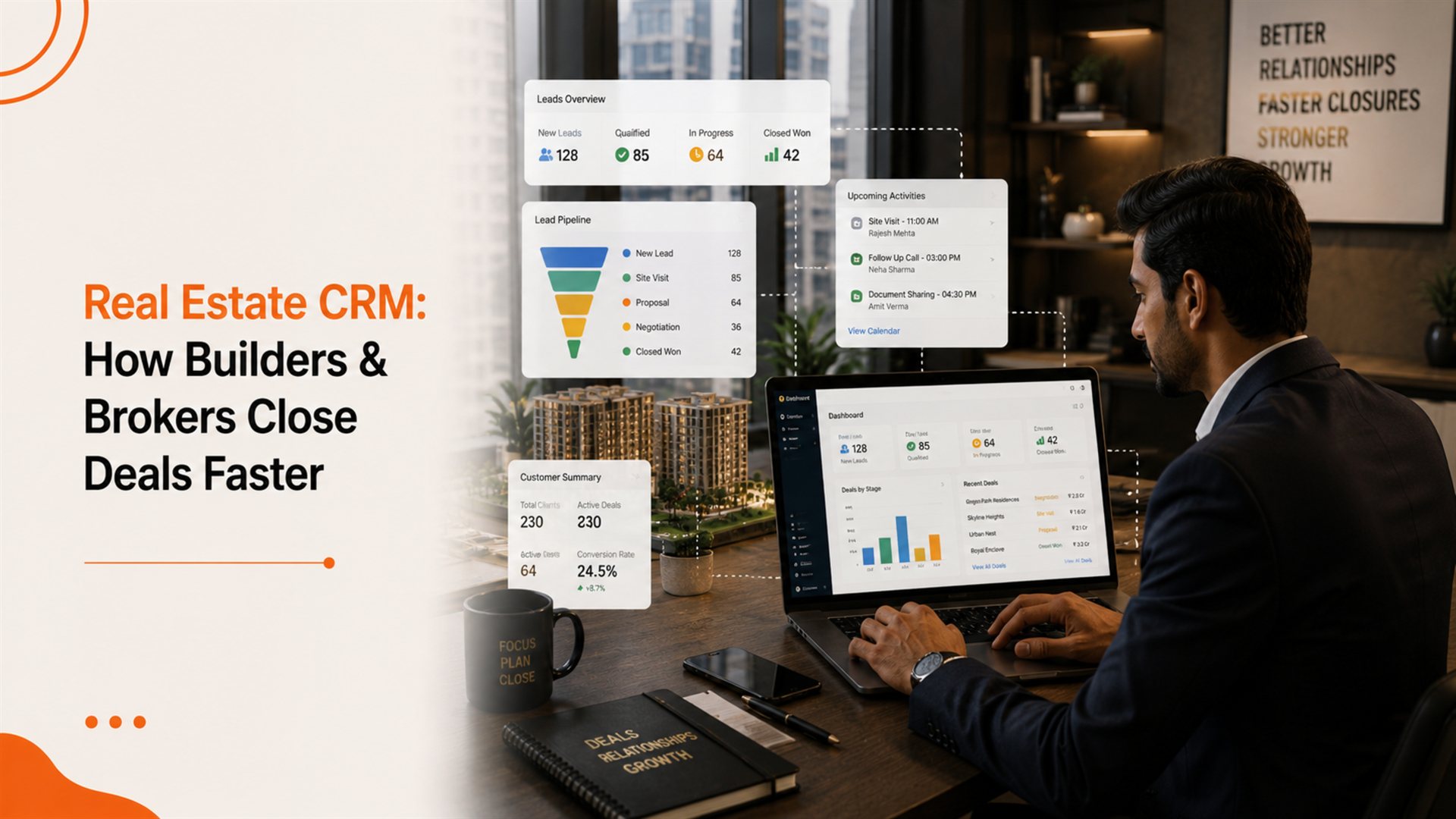
How a purpose-built real estate CRM helps builders and brokers in India manage inventory, channel partners, site visits and follow-ups in one place.
Real estate is the single industry where a CRM has the biggest direct impact on revenue — and where generic CRMs fail the hardest. A purpose-built [real estate CRM](/real-estate-crm) changes that.
Quick answer
A real estate CRM digitises project-wise inventory, lead management, site visits, channel partner relationships, payment plans, document trails and post-sales handover. Builders and brokers using one typically see 30–60% faster deal closures and 2–3× higher channel partner productivity.
Why generic CRMs fail in real estate
- No concept of project-wise inventory (tower / floor / unit)
- No channel partner sub-hierarchy or commission engine
- No site-visit scheduling with availability
- No payment plan / EMI tracking
- No RERA-ready document management
Core modules a real estate CRM must have
- Project + tower + unit-wise live inventory
- Lead capture from 99acres, MagicBricks, Housing.com, Meta and Google
- Auto-assignment with round-robin or CP-based routing
- Site-visit scheduling with calendar, reminders and visit feedback
- Channel partner module — onboarding, KYC, commissions, leaderboards
- Booking flow — token, agreement, payment plan, EMI tracker
- Document vault — KYC, agreement, allotment, possession
- WhatsApp automation for every lead stage
- Mobile app for site executives
How a CRM accelerates the deal cycle
Faster first response, scheduled site visits, structured nurture, automated CP communication, transparent inventory and one-click document handover collapse a typical 45-day deal into 18–25 days. That single change is usually worth 20–35% more closures per quarter.
Channel partner management: the underrated lever
For most Indian builders, 50–80% of sales come through channel partners. A real estate CRM gives every CP their own login, their own lead list, their own commission view and an automated payout report — eliminating the WhatsApp arguments and the missing commission calls that kill CP relationships.
AI on top of your real estate CRM
Layer AI lead automation on top and the CRM does even more: instant WhatsApp reply to every portal lead, automated qualifying questions, smart site-visit booking and 21-day nurture for cold leads. Most builders see CPL drop 30–40% within 60 days.
Implementation timeline for a builder
- Week 1 — projects, inventory, user roles configured
- Week 2 — portal integrations (99acres, MB, Housing, Meta)
- Week 3 — CP onboarding, commission rules, document templates
- Week 4 — WhatsApp automation, training, go-live
How Pacewalk helps
Pacewalk builds real estate CRM systems for builders, brokerage houses and channel partner networks across the Tricity, Delhi NCR and Mumbai. We handle setup, portal integrations, CP onboarding and team training. Contact us for a free demo with a real builder workflow.
Keep reading
Our Chandigarh team has done it for 1854+ brands. No obligation, no sales pressure.
Questions people ask about this
Why do real estate businesses need a specialised CRM?
Generic CRMs do not model project-wise inventory, channel partner hierarchies, site-visit workflows, payment plans or RERA-compliant document trails. A real estate CRM is purpose-built for all of these.
Can the CRM track channel partners and their commissions?
Yes. A proper real estate CRM tracks each channel partner, the leads they bring, the site visits they attend, the deals they close and auto-calculates commissions stage-wise.
Does it work for both builders and brokers?
Yes — with different role views. Builders see inventory + CP performance + collections. Brokers see assigned leads + inventory across projects + their commissions.
Experts in SEO, websites, branding and digital growth solutions. 12+ years helping Indian businesses scale online.
Ready to grow your business?
Tell us about your project — we'll respond within 2 hours.