The honest 2026 comparison of cloud CRM vs on-premise CRM for Indian businesses — security, cost, control, performance and the edge cases where each one still wins.
In 2026 the cloud vs on-premise debate is mostly settled — cloud wins for ~95% of Indian SMBs. But the remaining 5% of cases are real, and getting this wrong is expensive.
Quick answer
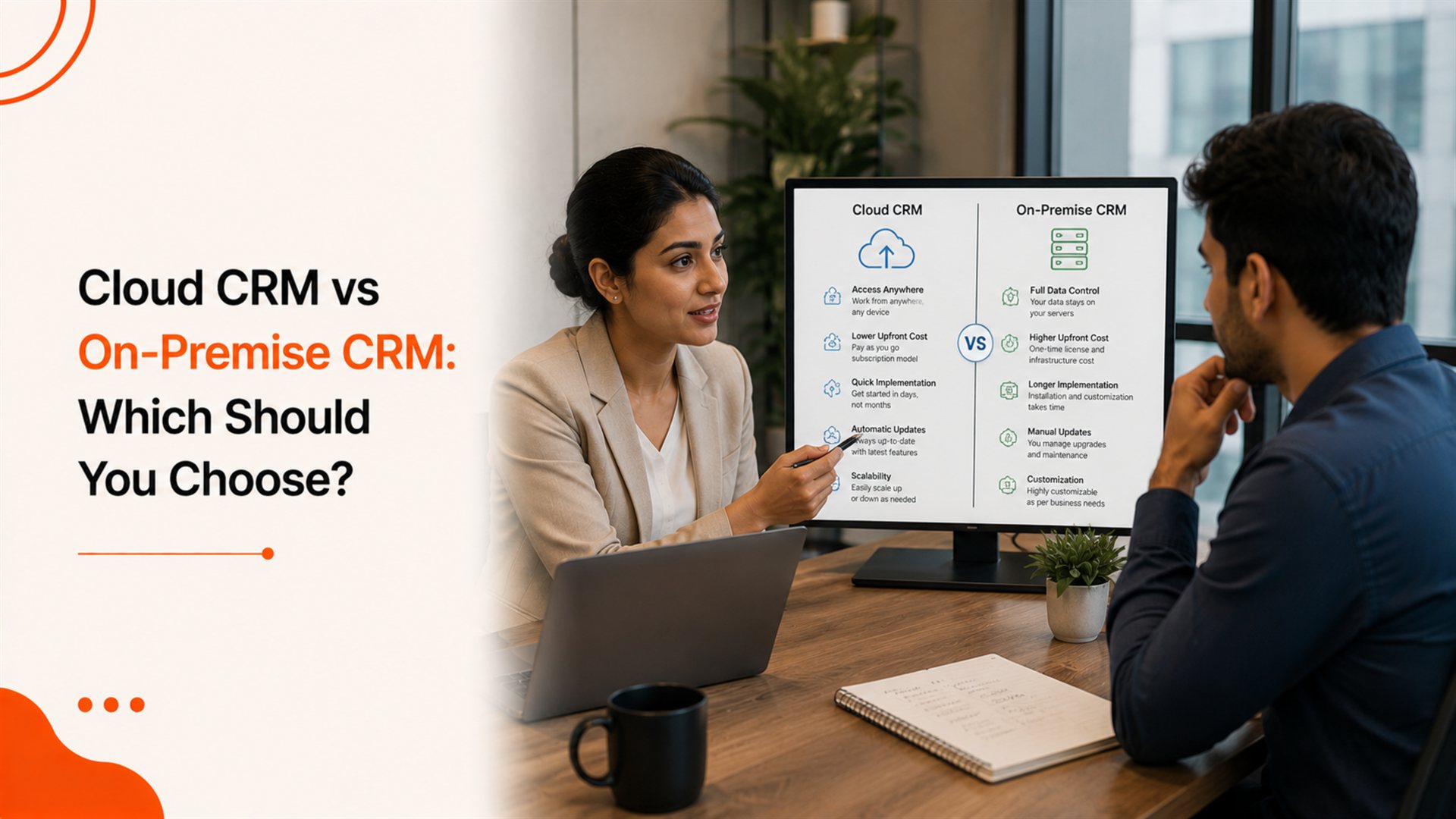
Choose cloud CRM if you have a distributed team, want zero server hassle and predictable pricing. Choose on-premise / private cloud only when you have strict data residency mandates, an existing private data centre or are running tens of thousands of users.
Cloud CRM — strengths
- No servers, no patching, no DBA — vendor handles everything
- Automatic backups + disaster recovery
- 99.9%+ uptime SLAs
- Works from anywhere — laptop, mobile, home, client site
- Updates and new features roll out continuously
- Predictable monthly cost — no surprise capex
Cloud CRM — weaknesses
- Total dependence on internet (mitigated by offline mobile app)
- Data lives on vendor infrastructure (mitigated by encryption + audits)
- Per-user pricing scales linearly
On-premise CRM — strengths
- Full data control inside your own servers
- Works inside an air-gapped network
- No per-user SaaS pricing
- Easy to enforce internal compliance / audit policies
On-premise CRM — weaknesses
- Heavy upfront capex on servers + licences
- Internal IT team needed for patching, backups, security
- Slower release cycle
- Hard for remote / field teams to use seamlessly
The hybrid model many enterprises pick
Run a custom CRM on a private cloud (AWS VPC / Azure tenant) with your own data, your own DR, your own audit logs — and SaaS-style performance and access. You get cloud benefits with on-premise level control.
Which path fits which business
- Under 100 users, distributed team → cloud
- BFSI / regulated / data residency mandates → private cloud
- Large enterprise with existing private DC → hybrid
- Mostly offline locations (warehouse, factory floors) → cloud with offline-first apps
How Pacewalk helps
Pacewalk builds cloud CRM software and custom CRM platforms deployed on AWS, Azure or your own infrastructure. Contact us for a free deployment recommendation.
Keep reading
Our Chandigarh team has done it for 1854+ brands. No obligation, no sales pressure.
Questions people ask about this
Is cloud CRM secure enough for sensitive data?
Yes — modern cloud CRMs run on AWS / Azure / GCP with encryption at rest, encryption in transit, audit logs, SOC 2 / ISO 27001 controls. Most are more secure than a typical SMB office server.
When does on-premise still make sense?
For BFSI / defence / government with strict data residency mandates, large enterprises with existing private clouds, or businesses with very slow or unreliable internet at all locations.
Can I move from on-premise to cloud later?
Yes, but it is a non-trivial migration. Most modern Indian SMBs should start on cloud and never look back.
Experts in SEO, websites, branding and digital growth solutions. 12+ years helping Indian businesses scale online.
Ready to grow your business?
Tell us about your project — we'll respond within 2 hours.