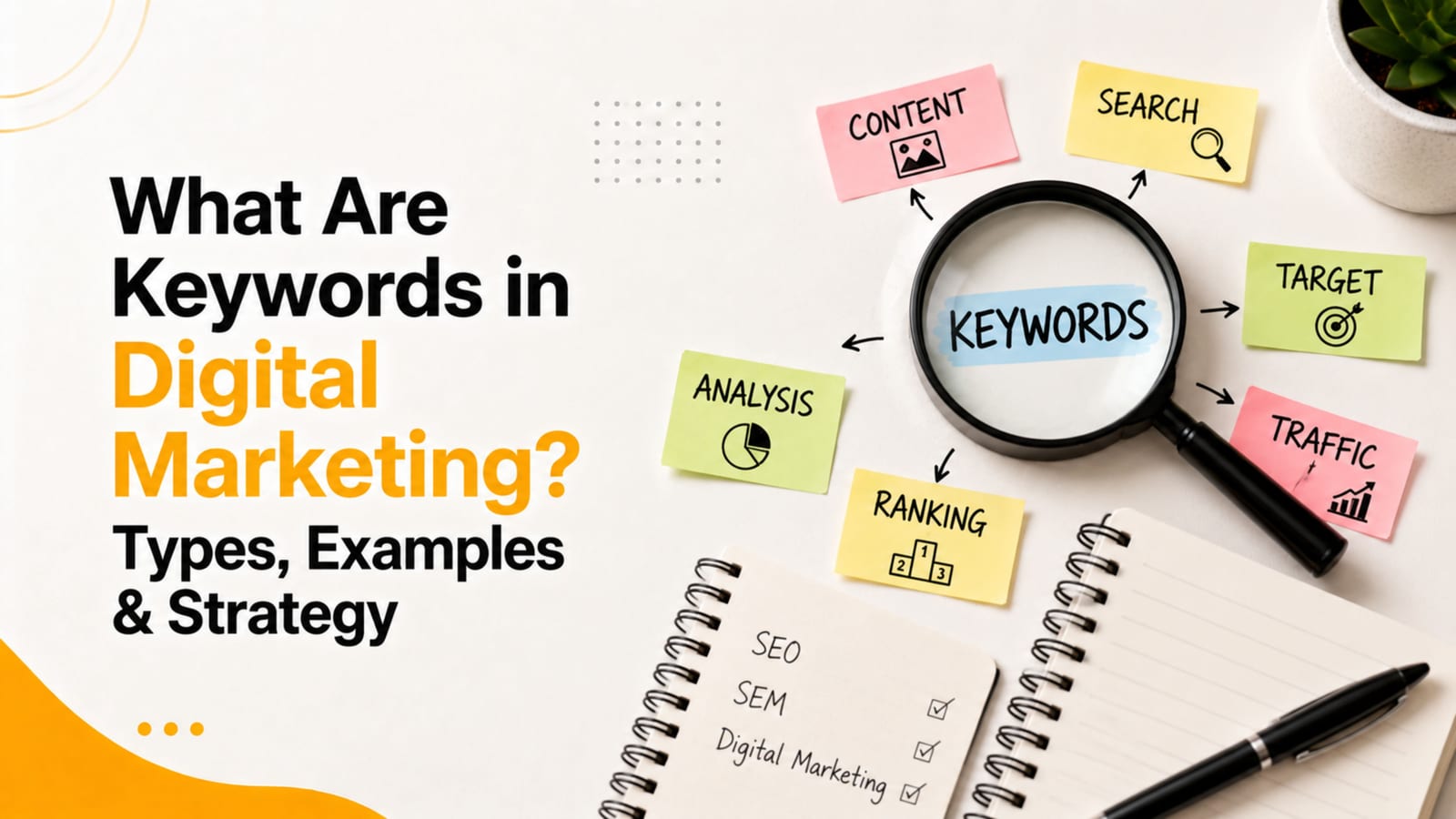
Understand what keywords are in digital marketing — types, examples, how they work in SEO and ads, plus tools and a step-by-step research process.
If digital marketing is the engine that drives modern businesses, keywords are the fuel. Every Google search, every YouTube query, every Amazon hunt — it all starts with a keyword. Get your keyword strategy right and customers find you. Get it wrong and you stay invisible, no matter how good your product is.
This guide breaks down what keywords are in digital marketing, the different types you need to know, how they work in SEO and ads, and the beginner mistakes that quietly waste budget.
What are keywords in digital marketing?
A keyword is the word or phrase a person types (or speaks) into a search engine when they're looking for information, a product or a service. In digital marketing, keywords are how we connect what people are searching for to the content, ads and pages we create.
For example, when someone searches 'best digital marketing agency in Chandigarh', that exact phrase is a keyword. Brands that have optimised their website, ads and Google Business Profile around that phrase have a real chance of showing up — and getting the lead.
Why keywords matter
- They reveal what your customers actually want — in their own words.
- They guide your SEO content strategy and on-page optimisation.
- They control where and how often your Google Ads appear.
- They shape the structure of your website, blog and landing pages.
- They're the bridge between intent and revenue.
Types of keywords you must know
1. Short-tail keywords (head terms)
1–2 words, very high volume, very high competition. Example: 'digital marketing', 'shoes', 'CRM'. Great for brand awareness, hard for small businesses to rank for organically.
2. Long-tail keywords
3+ words, lower volume, much higher buying intent. Example: 'affordable digital marketing agency for restaurants in Mohali'. Easier to rank for and usually convert 2–5x better than head terms.
3. Local keywords
Keywords with a city, area or 'near me' modifier. Example: 'salon near me', 'real estate agent in Zirakpur'. Critical for local businesses and tightly tied to Google Business Profile and local SEO.
4. Transactional keywords
Words that signal the user is ready to buy. Example: 'buy', 'price', 'book', 'hire', 'discount'. Highest commercial value — these belong on your service and product pages.
5. Informational keywords
'How to', 'what is', 'guide', 'tips'. Great for blog content and top-of-funnel traffic — like the very article you're reading right now.
6. Navigational keywords
Brand or product searches like 'Pacewalk reviews' or 'Zomato login'. They show how strong your brand recall is.
7. Branded vs non-branded
Branded keywords include your business name. Non-branded keywords describe the category. A healthy SEO portfolio needs both — branded for trust, non-branded for new customer acquisition.
How keywords work in SEO
Search engines crawl your pages, understand the topic and match it to user queries. When your page is well-optimised for a keyword and has strong authority, it ranks higher. The key elements:
- Title tag and H1 — should clearly include the primary keyword.
- Meta description — write for clicks, naturally include the keyword.
- URL slug — short, clean, keyword-rich.
- Content — covers the topic in depth, with related (semantic) keywords.
- Internal links — point to and from related pages with descriptive anchor text.
- Backlinks — high-quality external links boost authority for the target keyword.
How keywords work in Google Ads
In paid search, you bid on keywords. When a user's query matches (closely or loosely depending on match type), your ad enters an auction. Three ideas matter most:
- Match types — broad, phrase and exact control how loosely Google can interpret your keyword.
- Negative keywords — block irrelevant searches (e.g., adding 'free' as a negative keyword if you're a paid service).
- Quality Score — relevance between keyword, ad copy and landing page directly affects your cost per click.
How to do basic keyword research (step-by-step)
- List 10–15 'seed' words your customers might use to describe your product or service.
- Drop them into Google Keyword Planner, Ubersuggest or Semrush to expand into hundreds of variations.
- Filter by search volume, keyword difficulty and intent — keep the realistic, high-intent ones.
- Group keywords into clusters around a single topic (one cluster = one page).
- Map each cluster to either a service page, a city page or a blog post.
- Track rankings monthly and refresh content every 3–6 months.
Best free and paid keyword research tools
- Google Keyword Planner — free, accurate volumes (best when paired with an active Ads account).
- Google Search Console — shows the queries you're already ranking for.
- Ubersuggest — free tier, good for beginners.
- Ahrefs / Semrush — paid, the most powerful tools for serious SEO.
- AnswerThePublic — surfaces real questions people ask around a topic.
- Google autocomplete and 'People also ask' — free, underrated, reveals true intent.
Real-world examples
- A Chandigarh-based interior designer ranked for 'modular kitchen design Chandigarh' (long-tail + local) and added 12 qualified leads/month within 4 months.
- A SaaS company built blog clusters around informational keywords like 'what is HRMS', then internally linked to their pricing page — organic demos went up 3x in 6 months.
- A jewellery brand layered transactional keywords like 'buy gold ring online' on product pages, while using informational keywords on the blog to capture early-stage shoppers.
Common beginner mistakes to avoid
- Targeting only high-volume keywords — they're competitive and rarely convert for new sites.
- Ignoring search intent — ranking for the wrong type of keyword brings traffic but no leads.
- Keyword stuffing — repeating the keyword unnaturally hurts both rankings and readability.
- Putting multiple keyword clusters on one page — you end up ranking for none.
- Forgetting negative keywords in Google Ads — wasted spend on irrelevant clicks.
- Not tracking — if you're not measuring rankings and conversions, you're guessing.
Final word
Keywords aren't just SEO jargon — they're the language of your customer. Understand them, organise them, build content and ads around them, and you turn search engines into a 24/7 lead generation channel. Skip the basics and even the best-looking website stays buried on page 5.
Looking to grow your business online? Let Pacewalk build a keyword-led SEO and ads strategy that actually brings revenue.
Email hello@pacewalk.com · Call +91 95177-22444 · Get a free consultation or explore our SEO services and digital marketing services.
Our Chandigarh team has done it for 1854+ brands. No obligation, no sales pressure.
Questions people ask about this
What are keywords in digital marketing in simple words?
Keywords are the words and phrases people type into search engines like Google. In digital marketing, we use them to align our website content and ads with what customers are actively searching for.
What are the main types of keywords?
The most important types are short-tail, long-tail, local, transactional, informational, navigational, and branded vs non-branded keywords. A balanced strategy uses several types together.
What are long-tail keywords and why are they important?
Long-tail keywords are longer, more specific phrases (3+ words). They have lower search volume but much higher buying intent and lower competition, which makes them ideal for new and small businesses.
Which is the best free tool for keyword research?
Google Keyword Planner and Google Search Console are the best free tools. Pair them with Google autocomplete and 'People also ask' to discover real, intent-rich queries.
How many keywords should I target on one page?
Focus on one primary keyword per page, supported by 4–8 closely related secondary keywords and natural variations. Trying to rank a single page for unrelated keywords usually hurts performance.
Experts in SEO, websites, branding and digital growth solutions. 12+ years helping Indian businesses scale online.
Ready to grow your business?
Tell us about your project — we'll respond within 2 hours.